Guide 23: Loss analysis.
Guide 23
Overview
Distribution losses represent energy purchased at wholesale that never reaches customers. For a typical utility, losses account for 3-7% of total energy, translating to millions in annual revenue impact. Understanding where losses occur enables targeted infrastructure investment.
System Losses
SP&L snapshot: 479 kW total losses (3.4% of 14 MW load) across 1,363 contributing elements.
This loss rate is consistent with well-maintained distribution systems. Urban networks typically see 2-4% losses; rural systems with longer feeders can reach 6-8%.
Element Type Breakdown
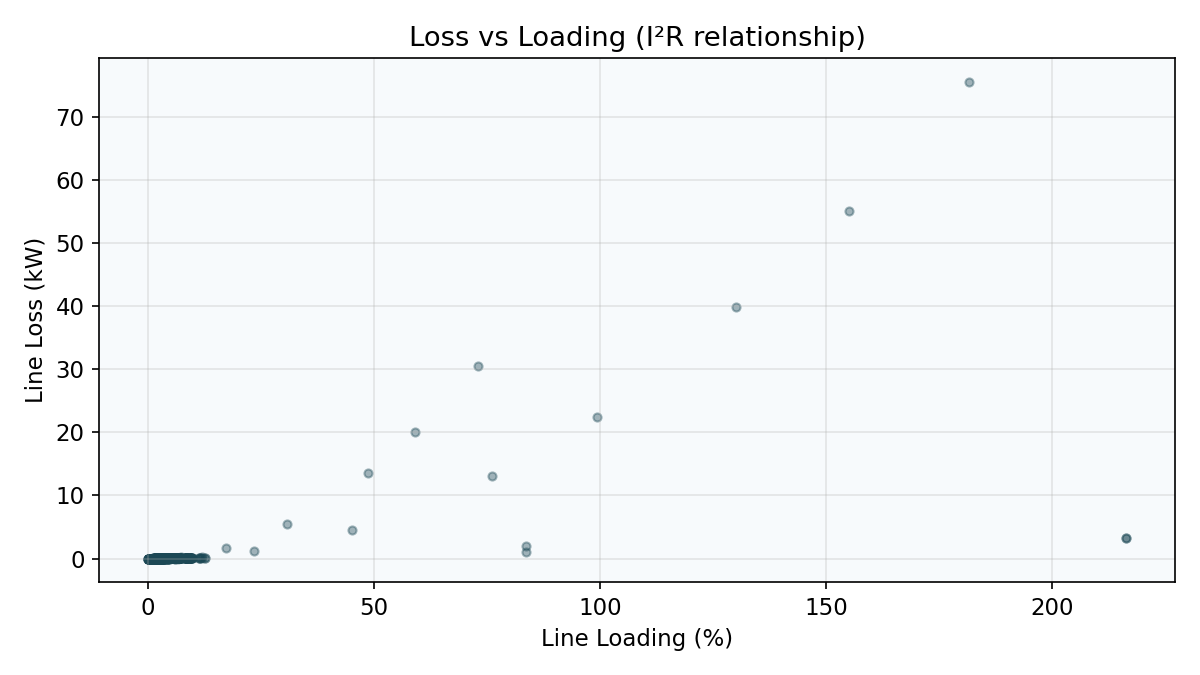
Distribution line conductors dominate losses through resistive (I²R) heating. The longer and more heavily loaded the conductor, the greater the loss. Transformer losses include:
- Core (no-load) losses: Fixed iron losses present whenever the transformer is energized
- Copper (load) losses: I²R losses in the windings that scale with load
Seasonal Variation
Time-series simulation (672 hourly snapshots across 4 representative weeks) reveals dramatic seasonal variation:
- Summer: 240 kW average losses, 463 kW peak (highest loading from cooling demand)
- Spring: 96 kW average losses, 34 kW minimum (mild temperatures, moderate load)
- Ratio: Summer average losses are 2.5x higher than spring
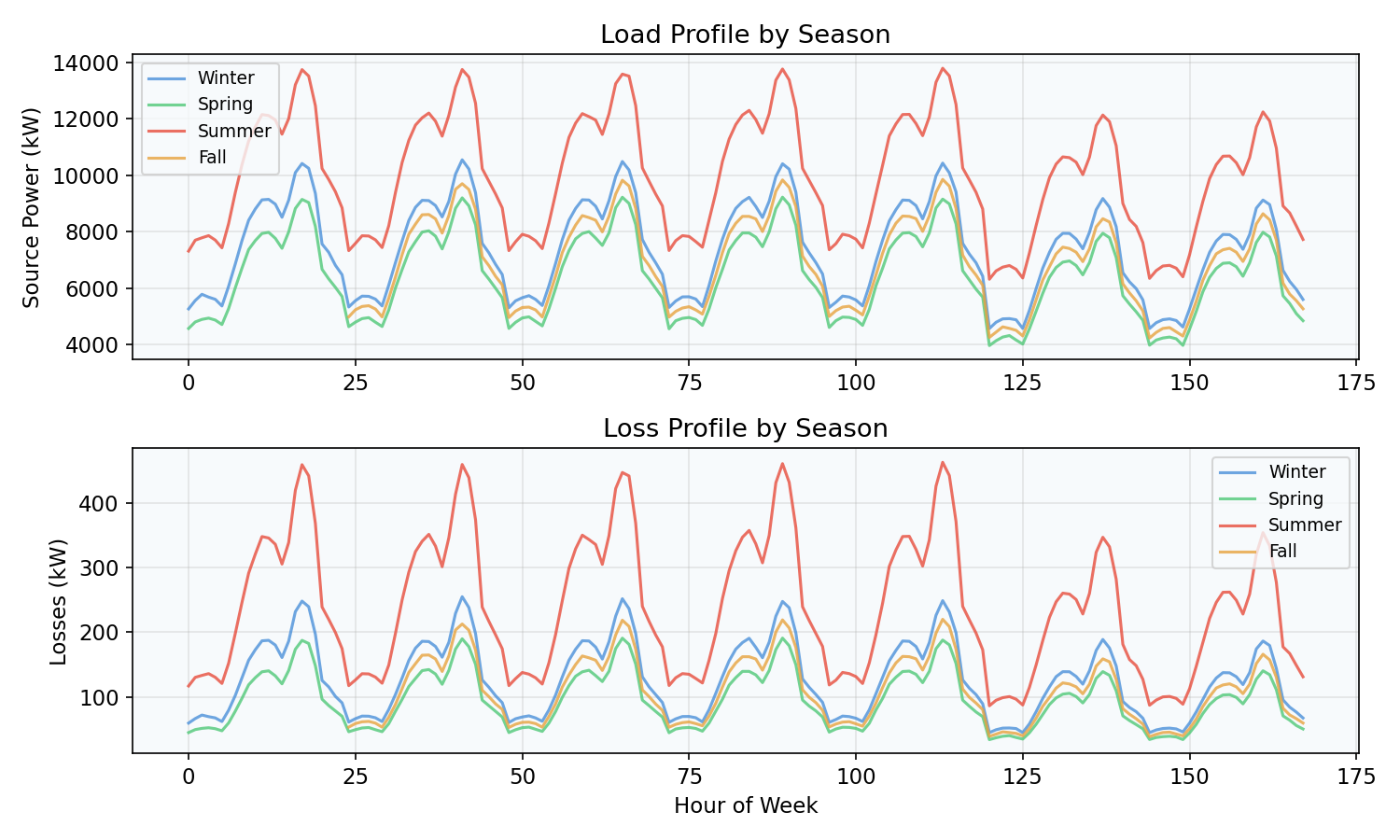
Because losses scale with the square of current, a 2x increase in load produces approximately 4x the losses. This quadratic relationship means peak hours contribute disproportionately to annual energy losses.
Loss Reduction Strategies
- Capacitor banks: Reduce reactive current flow, lowering I²R losses without infrastructure upgrades
- Conductor upgrades: Replace high-impedance laterals with lower-resistance conductors
- DER placement: Strategically located solar and storage reduces power flow on trunk lines
- Voltage optimization: Conservation voltage reduction (CVR) lowers voltage to reduce load and losses
Related Guides
- Guide 21: OpenDSS Power Flow -- Fundamentals of power flow analysis
- Guide 22: Hosting Capacity -- DER interconnection analysis